Texas Alyssa's Law — Is Your District Compliant?
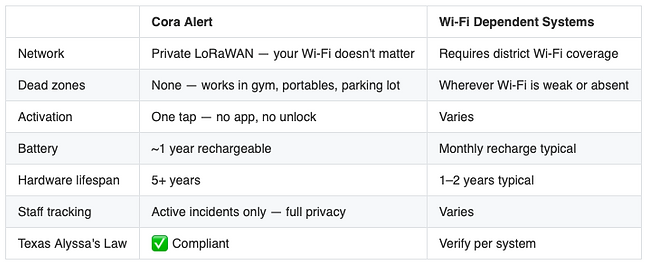
Texas requires silent panic alert technology in every classroom. Cora Alert exceeds the requirement — on a private LoRaWAN network that works when Wi-Fi or cellular fails.
Texas Alyssa's Law Is In Effect.
Is your district actually compliant?
Texas requires silent panic alert technology in every classroom for every public school district and open-enrollment charter school. The 2025–26 school year deadline is active.
If your current system — or the system you're evaluating — relies on district Wi-Fi, cell signal, or physical wiring, there's a compliance gap most vendors won't tell you about.
Book a 20-Minute Safety Conversation -->
The problem with Wi-Fi-dependent panic buttons
Every district in Texas has received the compliance memo. Most are evaluating systems. But there's a question most vendors won't answer clearly:
What happens when your Wi-Fi goes down?
Dead zones exist in every older school building — gyms, portable classrooms, parking lots, the older wings with thick concrete walls. These are exactly the locations where 60% of school safety incidents occur.
A panic button that doesn't work in your gym isn't a compliant system. It's a compliance checkbox with a coverage gap.
One tap. Room-level location. Works everywhere on campus.
Cora Alert uses a private LoRaWAN network — completely independent of your district's Wi-Fi, cellular, and IT infrastructure.
Funding your compliance
1. Every Texas school district receives annual per-pupil funding through the Texas School Safety Allotment — established by HB3 in 2019 and continuously appropriated since. These funds are designated specifically for school safety and security, and eligible uses include silent panic alert technology required under Alyssa's Law.
Unlike competitive grants, the Allotment is formula funding your district already receives. The question isn't whether the money is available — it's whether it's been planned into your current budget. Most districts can fund Alyssa's Law compliance from this existing allocation without waiting for a grant cycle to open.
We can help you map Cora Alert costs to your School Safety Allotment line item during our 20-minute conversation.
2. The federal COPS School Violence Prevention Program (SVPP) is an annual competitive grant that covers up to 75% of qualifying safety system costs — up to $500,000 per district. Applications typically open each spring.
We're happy to discuss how Cora Alert fits into your district's SVPP application when the FY26 cycle opens.
A full campus safety system — not just a panic button
-
Alert Locator Tags — wearable, IP67 water/shock resistant, ~1-year battery. One tap activates a silent alert.
-
BLE Beacons — installed in every classroom. Provides room-level accuracy so responders know exactly where to go.
-
LoRaWAN Gateways — private network, up to 1,000 ft range, penetrates complex structures.
-
Alert Panel — fixed display showing staff location and alert status in real time.
-
AI incident summarization — real-time summary of what's happening so responders know the situation before they arrive.
-
Facilities sensors (available) — door/window sensors verify your locked-door policy is actually working, not just assumed to be.
20 minutes. No sales pressure. Just answers.
We talk to Texas safety directors, superintendents, and technology directors every week. Most conversations are about the same three things: does it really work in our oldest building, what does the IT team need to do, and how do we get this approved.
We can answer all three in 20 minutes.
Book Your 20-Minute Conversation